Every organisation has a culture. Some cultures inspire innovation. Some create continuous improvement. Others unintentionally create fear, bureaucracy and resistance to change. The challenge is that culture is often misunderstood. Leadership teams invest heavily in transformation programmes. They redesign structures. Introduce Lean tools. Deploy digital technologies. Rewrite vision statements. Launch engagement initiatives. Yet months later, very little has fundamentally changed. Processes may look different. People often behave exactly as they did before. The reason is simple. Culture does not change because leaders announce it. Culture changes because leaders consistently shape the environment in which people think, decide and act. Few people understood this better than Professor Edgar Schein. His work remains one of the most influential frameworks for understanding organisational culture and one of the most overlooked foundations of Lean Thinking and Operational Excellence. Toyota did not become world-class because it introduced better tools. It became world-class because it deliberately created a culture where continuous improvement became normal. For leaders seeking sustainable transformation, that distinction changes everything.
Culture Is What People Do When Nobody Is Watching
Many organisations describe culture using values displayed on walls. Integrity. Respect. Innovation. Collaboration. Customer Focus. These aspirations are important. They are not culture. Schein argued that culture exists at three interconnected levels.
Artifacts
The visible elements. Processes. Meetings. Visual boards. Standard Work. Dress codes. Factory layouts. Leadership behaviours.
Espoused Values
The principles leaders say they believe. Customer First. Safety. Continuous Improvement. Respect for People. Operational Excellence.
Underlying Assumptions
The invisible beliefs that determine everyday behaviour. Can people safely speak up? Are problems viewed as failures or opportunities to learn? Is leadership about control or coaching? Do people improve processes or simply follow them? These assumptions determine culture. Everything else is evidence of it.
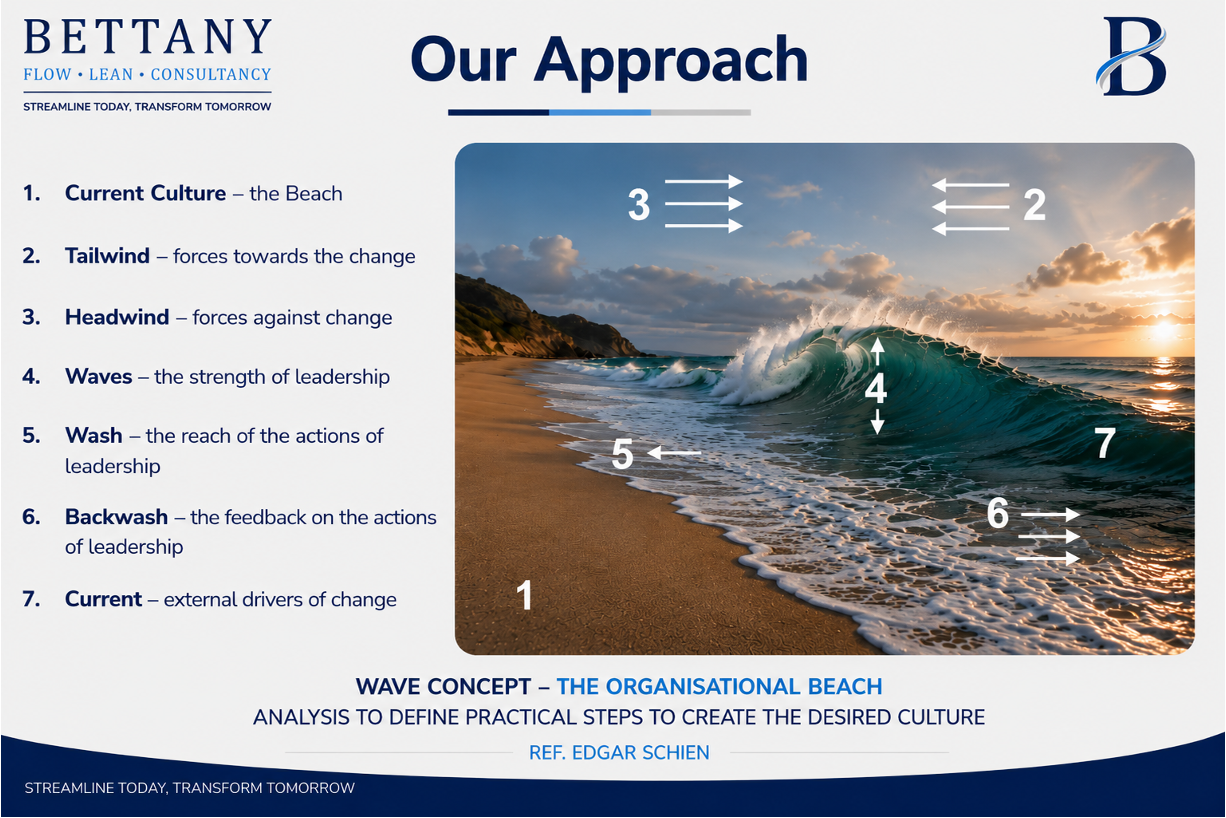
The Organisational Beach
Imagine an organisation as a beach. Above the waterline we see what everyone notices first. Performance metrics. Visual Management. Daily meetings. Improvement boards. Technology. Training. Processes. These are the visible features. Like sand, rocks and waves, they attract immediate attention. But beneath the surface lies something far more powerful. The tide. The currents. The shape of the seabed. These hidden forces determine how everything above behaves. Organisations are no different. Beneath visible processes lie deeply held assumptions. How leaders respond when mistakes occur. Whether problems are hidden or exposed. Whether people wait for permission or take ownership. Whether improvement is expected—or avoided. These invisible beliefs quietly shape every decision made throughout the organisation. The beach changes every day. But it is the tide beneath it that determines its shape. Culture works in exactly the same way.
Lean Tools Cannot Change Culture Alone
Many organisations begin their Lean journey by introducing familiar tools. 5S. Visual Management. A3 Problem Solving. Value Stream Mapping. Daily Management. Standard Work. These are valuable. But they cannot overcome a culture that rewards different behaviours. Visual boards become wallpaper. Daily meetings become reporting sessions. Standard Work becomes paperwork. Problem solving becomes blame avoidance. Nothing is wrong with the tools. The culture simply rejects them. Toyota never viewed Lean as a toolkit. The tools supported a culture that already valued learning, experimentation and respect for people. Without those cultural foundations, Lean quickly becomes another improvement programme.
Leaders Create the Conditions for Improvement
Schein believed culture develops through repeated leadership behaviour. People observe what leaders pay attention to. What leaders celebrate. What leaders tolerate. What leaders ignore. These repeated signals become assumptions. Those assumptions become habits. Those habits become culture. This aligns perfectly with Lean leadership. When leaders spend time at the Gemba… People recognise that understanding work matters. When leaders ask questions instead of giving answers… People begin thinking differently. When leaders respond to problems with curiosity rather than blame… Improvement accelerates. When leaders coach rather than command… Capability grows. Culture is not created during annual conferences. It is created during ordinary conversations. Every day.
The Lean Beach
Imagine two organisations standing on neighbouring beaches. Both possess talented people. Both have similar technology. Both have invested in Lean. On the first beach: Problems are hidden beneath the sand. People avoid difficult conversations. Departments protect their own priorities. Leaders solve every problem themselves. The sea appears calm. Until the first storm arrives. On the second beach: Problems are visible like driftwood washed ashore. Teams gather around them. People investigate causes rather than blame individuals. Standard Work evolves continuously. Ideas flow as freely as the tide. Leaders coach rather than control. The waves still arrive. The difference is that the organisation has learned how to navigate them. The beach has become resilient. That is the power of culture.
Lean Principles Shape the Shoreline
The five principles of Lean naturally reinforce a healthy organisational culture.
Define Value
Everyone understands why the organisation exists. The customer becomes the reference point for every decision.
Map the Value Stream
Work becomes visible. Barriers become easier to remove. Departments begin collaborating rather than competing.
Create Flow
People focus on completing work rather than accumulating activity. Bottlenecks become opportunities for learning.
Establish Pull
Resources respond to real demand rather than assumptions. Teams become more adaptable. Priorities become clearer.
Pursue Perfection
Improvement becomes part of everyday work. Learning replaces blame. Curiosity replaces certainty. The shoreline is reshaped every day by countless small improvements. Together, these principles create far more than operational efficiency. They create culture.
Culture Determines Whether Improvement Lasts
Many transformation programmes succeed initially. New processes are introduced. Performance improves. Momentum builds. Then leadership attention moves elsewhere. Old habits quietly return. The organisation slips backwards. Schein explained why. Unless underlying assumptions change, behaviour eventually returns to familiar patterns. Sustainable transformation therefore requires more than implementing Lean. It requires reshaping the beliefs that guide everyday decisions. Only then do improvements become self-sustaining.
The Bettany Flow Lean Consultancy Perspective
At Bettany Flow Lean Consultancy, we believe Operational Excellence begins long before improvement tools are introduced. It begins with culture. Lean is not something organisations implement. It is something organisations become. The greatest competitive advantage is not better technology. It is creating a culture where people continuously improve the way work is done. Where leaders develop capability rather than dependency. Where problems become opportunities to learn. Where value flows because people work together around a shared purpose. Edgar Schein showed us that culture is never accidental. Toyota demonstrated what becomes possible when culture and systems reinforce one another. Together they provide one of the most powerful lessons in modern leadership. If leaders want to transform performance… They must first transform the environment that shapes behaviour. Because culture is not the outcome of Operational Excellence. It is its foundation.
Leadership Reflection
Before launching your next improvement initiative, ask five questions:
• What assumptions are driving the behaviours we see every day?
• Are our leadership behaviours reinforcing the culture we aspire to create?
• Do our Lean tools encourage learning—or simply compliance?
• What lies beneath the surface of our organisational “beach”?
• Are we changing processes—or are we changing the beliefs that sustain them?
The organisations that endure are not those with the most sophisticated improvement systems. They are those whose leaders intentionally shape cultures where learning, trust, respect and continuous improvement become part of everyday life. Because the strongest organisations are built like resilient coastlines. Their visible success is sustained by powerful foundations beneath the surface. That is Edgar Schein’s enduring legacy. And it remains one of the most important lessons for leaders committed to Lean Thinking and Operational Excellence today.