Streamline Today, Transform Tomorrow
A Practical Model for SME Growth in an Increasingly Complex World
Most improvement programmes do not fail because people lack commitment. They stall because the organisation has not created the conditions for improvement to become part of everyday work.
For more than over three decades, Bettany Flow has led Lean, Operational Excellence transformation programmes within both SME’s and blue-chip organisations.
What have we learnt on the success of these Lean and operational excellence initiatives?
The language has changed. The tools have evolved. Technology has accelerated. But one challenge remains remarkably consistent: How do you create improvement that lasts?
For SMEs, the challenge is even greater.
Resources are limited. Leadership capacity is stretched. Customer expectations continue to rise. Supply chains are increasingly interconnected. Digitalisation creates opportunity but also complexity. Regulatory requirements increase. Skilled people are difficult to replace.
And yet the expectation remains the same:
Grow. Improve. Deliver. Adapt.
The temptation is to respond by doing more. More initiatives. More projects. More systems. More meetings. More targets. More change.
But complexity rarely responds well to more complexity. The answer is to create flow.
Flow of value.
Flow of knowledge.
Flow of information.
Flow of decisions.
And ultimately, the flow of capability.
This is where a different approach to Operational Excellence becomes necessary.
Complexity Is Not the Problem
Complexity itself is not necessarily a problem. Modern organisations are complex because their customers, products, technologies and markets are complex. The problem occurs when complexity becomes unmanaged. A customer request moves through Sales. Then Engineering. Then Planning. Then Procurement. Then Operations. Then Quality. Then Logistics.
At every stage there are decisions, information exchanges, approvals and potential delays. The physical product may move efficiently. The information required to make that product happen may not. This creates an important distinction. An organisation can have efficient processes and still have poor flow. Why? Because flow is created by the entire system. Not by individual departments.
The Hidden Cost of Improvement
One of the unintended consequences of modern management is the accumulation of initiatives. A business begins with a strategic priority. Then comes an improvement programme. A digitalisation programme. A quality initiative. A new ERP system. A leadership programme. A cost reduction project. A customer experience programme.
Individually, each may make perfect sense. Collectively, they can overwhelm the organisation. People become busy delivering change rather than improving the business. The organisation starts more work than it can finish.
This is where Little's Law provides a powerful reminder:
Lead Time = Work in Progress ÷ Throughput
The more work we put into the system, without increasing throughput, the longer everything takes. For an SME, this matters enormously. The answer is not necessarily another initiative. Sometimes the most powerful improvement is deciding what not to do.
From Activity to Value
Operational Excellence begins by asking a deceptively simple question: What does the customer value?
That question sounds obvious. Yet many organisations measure themselves through internal activity. Utilisation. Meetings completed. Reports produced. Orders processed. Projects started. Tasks closed.
These measures can create the illusion of progress.
But customers do not buy activity. They buy outcomes. They want the right product or service.
At the right quality.
At the right time.
At the right cost.
With the right experience.
The organisation therefore needs to understand how value travels from customer demand throughout the business. That means looking beyond individual processes. It means understanding the value streams both operational and transactional.
See the Whole System
Traditional Lean Value Stream Mapping has provided organisations with a powerful way to understand how material and information flow through operations. But today's complexity demands a broader perspective. The value stream does not begin when a machine starts. It may begin with a customer enquiry. A quotation. An engineering decision. A design change. A procurement request. A planning decision. An approval. A piece of information.
These transactional systems can create enormous amounts of hidden Work in Progress.
Emails waiting for responses. Orders waiting for approval. Engineering work waiting for information. Quotes waiting for commercial decisions. Projects waiting for resources. The physical operation may be flowing.
The transactional system may be full of queues.
True Operational Excellence requires both to be understood.
Capability Is the Real Transformation
Technology can change a process. Consultants can redesign a system. A new operating model can change responsibilities. But none of these automatically creates organisational capability. Capability is created when people understand:
What we are trying to achieve.
Why it matters.
How the work should be performed.
How to recognise a problem.
How to solve it.
How to improve it.
This is why Standard Work, coaching, problem solving and daily management are so important. They create the routines through which knowledge becomes capability.
And capability is what allows improvement to continue when the consultant leaves.
The 90-Day Trap
Many improvement programmes begin with enormous energy. The launch is successful. People are engaged. New processes are introduced. Performance initially improves. Then something happens. Leadership attention moves elsewhere. The improvement team moves onto another project. The daily routines weaken. Standards stop being followed. Problems become normal again.
Within months, the organisation gradually returns to its previous state. The issue was not the original intervention. The issue was the absence of an operating rhythm capable of sustaining it.
Sustainable improvement requires routines that become part of how the organisation runs. Daily. Weekly. Monthly.
Leadership must repeatedly ask:
What is the current condition?
What is preventing flow?
What are we learning?
What needs to change?
How do we know?
This is where improvement becomes a management system rather than a programme.
The Bettany Model: Streamline Today. Transform Tomorrow.
Our approach is built around a simple belief: Transformation should leave the organisation stronger than when we found it. That means creating capability rather than dependency.
We see the journey through four connected dimensions – our Bettany Flow 4 C’s model.
1. Consult
Understand -Create clarity around purpose, strategy, customer value and the current condition. Before improving the system, understand it.
2. Create
Streamline -Identify where value is being interrupted. Reduce unnecessary complexity. Improve flow. Remove barriers. Focus resources on the vital few priorities.
3. Change
Build Capability -Develop leaders and teams through coaching, problem solving, Standard Work and practical knowledge transfer. Improvement becomes something people can do—not something consultants do to them.
4. Continue
Sustain -Create the routines, behaviours and management systems that allow performance to continue improving. The objective is not to finish a transformation programme. The objective is to create an organisation capable of transforming itself.
The SME Advantage
SMEs often see their size as a limitation. In reality it can be an enormous advantage. Decision-making can be faster. Leadership is closer to the work. Communication can be more direct. People can see the impact of their contribution. The challenge is that SMEs cannot afford large transformation programmes that create more complexity than they remove. They need practical improvement. Practical Steps and Real Results. Focused intervention. Visible results. Capability that stays.
A bespoke roadmap rather than an off-the-shelf Lean implementation.
Because no two organisations start from the same place. And therefore, no two should follow exactly the same journey.
Transformation Is a Leadership System
Ultimately, Operational Excellence is not a department's responsibility. It is a leadership responsibility. Leaders determine the priorities. Leaders determine what receives attention. Leaders establish the behaviours that become culture. Leaders decide whether problems are hidden or exposed. Leaders decide whether people are developed or directed. Leaders determine whether improvement becomes part of everyday work. The role of leadership is therefore changing. It is not simply to manage today's performance. It is to create the capability for tomorrow's performance. That is the difference between managing an organisation and building a culture for growth and sustainability.
The Bettany Perspective
At Bettany Flow Lean Consultancy, our purpose is simple:
To leave every organisation stronger than we found it.
We do not believe SMEs need another generic transformation programme.
They need clarity. They need focus. They need practical systems. They need leaders who can develop people. And they need improvement that becomes self-sustaining.
The future belongs to organisations that can continuously adapt without continuously disrupting themselves.That requires a different way of thinking.
Streamline today. Create flow. Develop capability – process and people. Build the routines. Learn from the work.
Then use that capability to transform tomorrow by
Empowering People. Strengthening Processes. Delivering Sustainable Results.
Because the ultimate measure of a successful consultancy engagement is not how much the consultant delivered.
It is how much more capable the organisation became.
Leadership Reflection
Before launching the next improvement initiative, ask:
• Are we solving the real business problem—or simply adding another programme?
• Where is value waiting within our operational and transactional systems?
• How much Work in Progress can our organisation realistically handle?
• Are our leaders developing capability or creating dependency?
• What routines will ensure today's improvement continues tomorrow?
• If the consultants disappeared tomorrow, would the organisation continue improving?
The answer to that final question may be the most important measure of Operational Excellence. Because sustainable growth is not created by doing more.
It is created by creating better flow, stronger capability and greater organisational capacity to learn.
Streamline Today. Transform Tomorrow.
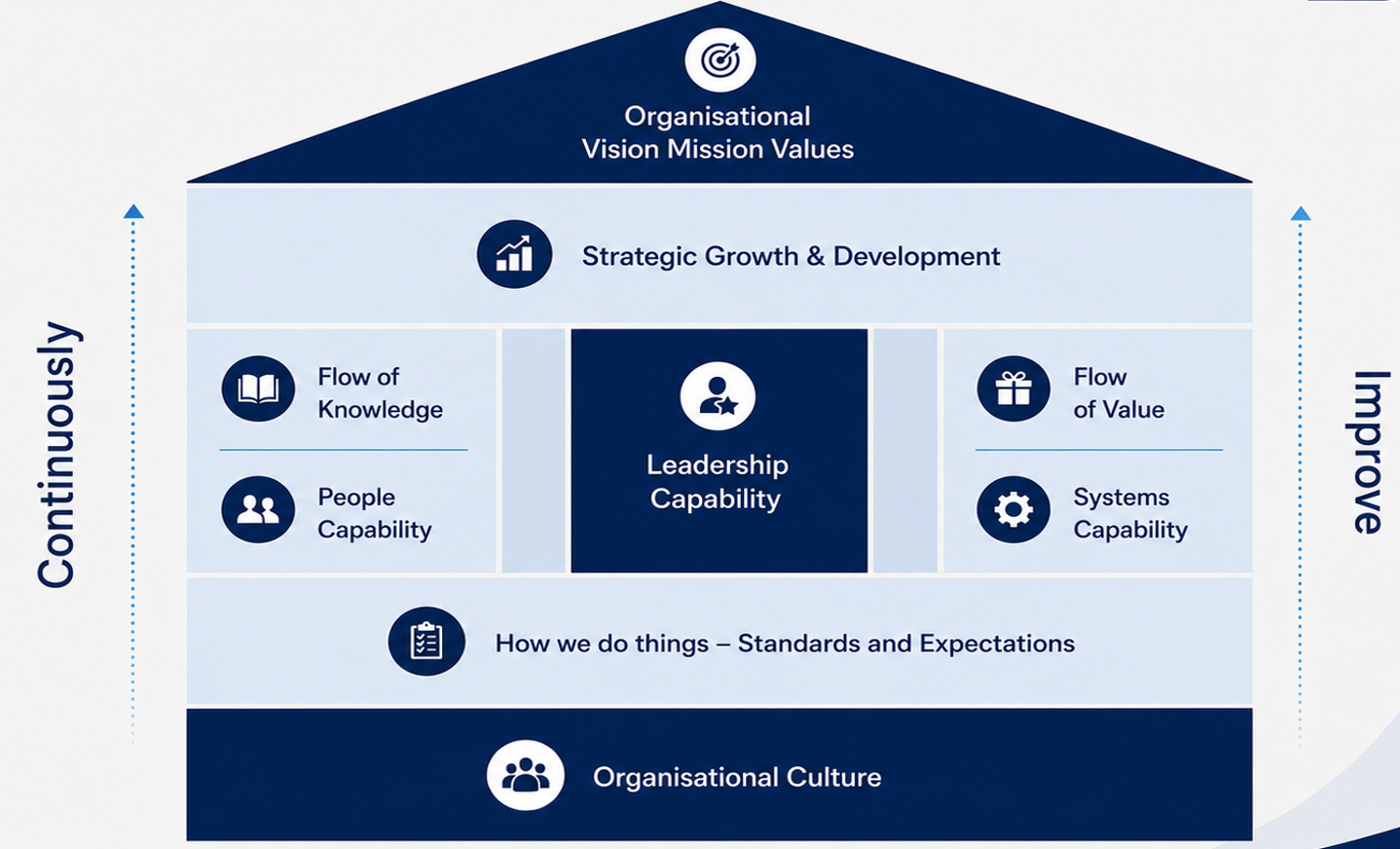
Flow of Knowledge · Flow of Value · Leadership Capability